
Large Format Tile Installation Irvine CA
Large format tile installation Irvine CA projects require more planning and surface preparation than smaller traditional tile formats. Large porcelain pieces can create a clean, modern look with fewer grout joints, but their size makes substrate flatness, mortar coverage, handling, layout, and alignment especially important.
Irvine Tile Pros installs large-format porcelain on floors and walls in homes and commercial spaces throughout Irvine, including 24×48 tile, large bathroom and shower tile, feature walls, and expansive floor areas.
Large Format Tile Installation Irvine CA for Porcelain Floors & Walls
Large-format porcelain works well in contemporary Irvine interiors because larger pieces can create a more continuous visual surface with fewer grout lines. The same size that creates that appearance also makes installation less forgiving of uneven substrates and poorly planned layouts.
The tile dimensions, room geometry, transitions, perimeter cuts, and surface condition should all be considered before setting begins. Large-format installation is not simply the same process with a bigger tile.
Large Format Porcelain Tile for Irvine Homes
One of the most common large-format choices is 24×48 porcelain tile, although larger and differently proportioned formats are also available.
Large porcelain can be used for:
- Open living-area floors
- Kitchens and dining areas
- Entryways
- Bathroom floors
- Shower walls
- Tub surrounds
- Fireplace and feature walls
- Commercial floors and wall applications
Porcelain is available in stone-look, concrete-look, marble-look, solid-color, and textured finishes, allowing large-format installations to range from subtle and minimal to highly architectural.
Why Large Format Tile Requires More Preparation
A larger tile bridges a greater area of the substrate than a smaller tile. Minor surface irregularities that might be manageable with a smaller format can become much more noticeable when a long porcelain piece spans them.
Preparation may include evaluating:
- Substrate flatness
- Existing cracks or movement
- Floor transitions
- Wall plumb and flatness
- Doorway heights
- Tile thickness
- Planned grout-joint locations
- Perimeter cuts
Leveling clips can help control the relationship between neighboring tiles during installation, but they do not flatten an uneven substrate. Surface preparation comes first.
Substrate Flatness Matters
Large-format tile performs best over a surface that is appropriately flat for the selected tile and installation conditions.
On floors, high or low areas can make large pieces difficult to align consistently. On walls, surface irregularities can become especially visible with long vertical or horizontal grout joints.
Where correction is needed, the substrate should be addressed before tile setting rather than relying on excessive mortar thickness or leveling clips to compensate for an uneven surface.
For broader floor-installation information, see our floor tile installation page.
Mortar Coverage & Tile Support
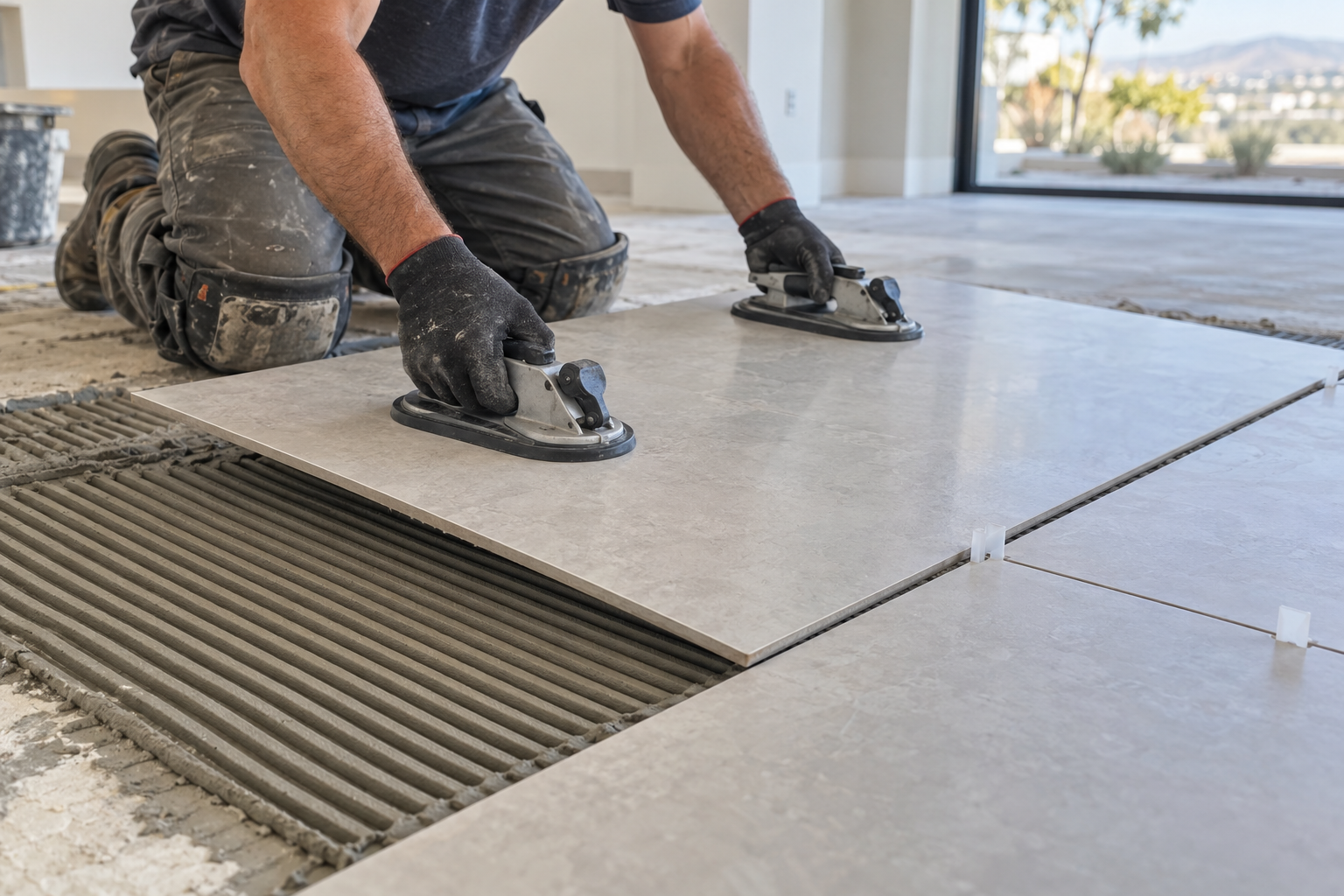
Large porcelain requires careful attention to how mortar is applied and how the tile is placed.
Straight, parallel mortar ridges help the tile collapse the mortar as it is embedded into position. Appropriate trowel selection depends on the tile, substrate, setting material, and project conditions. Back-buttering may also be appropriate for certain large-format installations.
The goal is consistent support beneath the tile rather than large unsupported voids that can increase the risk of damage.
Controlling Lippage & Grout-Joint Alignment
Lippage is the difference in elevation between the edges of neighboring tiles.
Because large-format tiles create long edges, even modest differences can become visually noticeable. Substrate preparation, tile dimensional consistency, layout, mortar application, and careful placement all contribute to controlling lippage.
Tile-leveling systems may be used as an installation aid to help neighboring pieces remain aligned while the mortar cures. They are not a substitute for a properly prepared substrate.
Grout-joint planning also matters. Long joints tend to draw the eye, so alignment should be considered in relation to walls, doors, cabinets, plumbing fixtures, and other architectural features.
Large Format Floor Tile
Large-format porcelain can work especially well across open living areas where homeowners want fewer grout joints and a more continuous floor appearance.
Before installation, the layout should account for:
- Main sight lines
- Room dimensions
- Doorways
- Adjacent flooring
- Perimeter cuts
- Transitions between rooms
The objective is to avoid awkward narrow cuts while maintaining a balanced layout across the visible space.
See our floor tile installation page for more information about floor preparation and installation.
Large Format Bathroom & Shower Tile
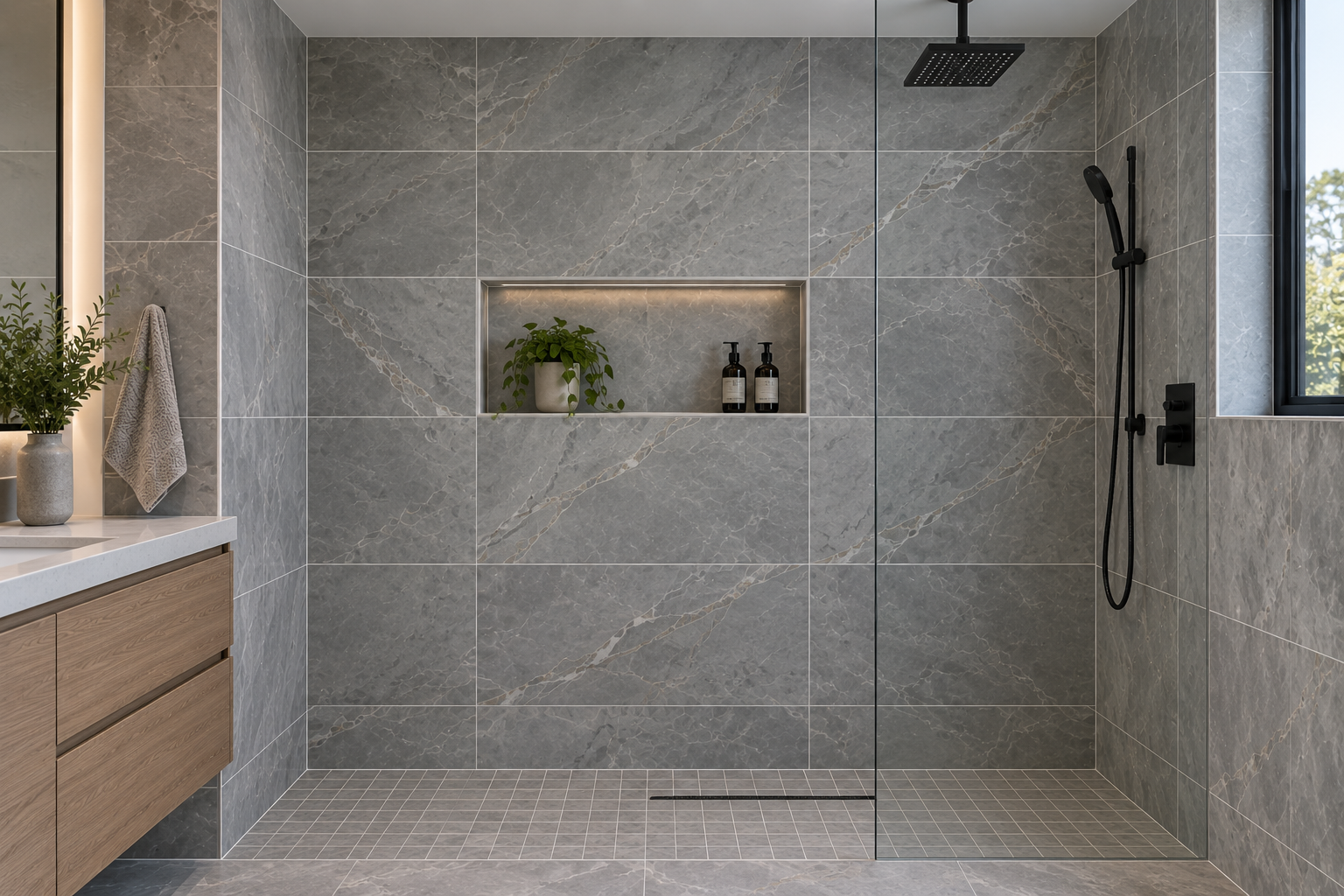
Large-format porcelain can create a clean appearance on bathroom and shower walls because fewer grout joints interrupt the surface.
Shower installations also require the tile work to integrate correctly with the underlying waterproofing assembly, niches, benches, plumbing penetrations, and changes of plane.
Large tile does not replace proper waterproofing or substrate preparation. Those systems need to be completed before the finish tile is installed.
For wet-area installation details, see shower tile installation and waterproofing or bathroom tile installation.
Ready to Plan a Large-Format Tile Project?
Large tile can create a striking finished surface, but the details beneath it matter just as much as the tile itself.
Large Format Feature Walls
Large-format porcelain is not limited to floors.
It can also be used for:
- Fireplace walls
- Bathroom feature walls
- Accent walls
- Reception walls
- Commercial feature surfaces
Large wall tile requires planning around the dimensions of the wall, visible cuts, outlets, niches, fixtures, and finished edges.
Where possible, joint placement can be coordinated with surrounding architectural lines so the finished wall feels deliberate rather than divided randomly.
Large Format Tile in Commercial Spaces
Large porcelain is also used in commercial interiors where a clean, contemporary appearance and durable surface are important.
Possible applications include:
- Lobbies
- Reception areas
- Office common areas
- Commercial restrooms
- Retail interiors
- Feature walls
Commercial projects may also involve transitions to carpet, LVT, concrete, or other flooring systems.
For additional commercial applications, see commercial tile installation in Irvine.
Layout, Cuts & Transitions
Large pieces require more planning before the first tile is set.
A layout should consider where grout joints will land, how the tile will terminate against walls and cabinetry, and how cuts will appear around doorways and fixtures.
Transitions also need to account for differences in finished floor height between tile and adjacent materials.
For recognized tile installation methods and industry standards, see the Tile Council of North America.
What Affects Large Format Tile Installation Cost?
Large-format tile pricing depends on more than square footage.
Factors can include:
- Tile size and material
- Existing surface condition
- Substrate correction
- Demolition
- Floor or wall application
- Number and difficulty of cuts
- Tile handling requirements
- Niches or penetrations
- Transitions
- Layout complexity
- Grout and finishing details
A straightforward open floor can involve a very different amount of labor than a shower wall or feature wall using the same tile size.
See the Irvine tile installation cost guide for broader pricing information.
How Long Does Large Format Tile Installation Take?
The timeline depends on the project.
Substrate correction, demolition, tile dimensions, layout complexity, cutting, handling, grout, and cure time can all affect the schedule.
A smaller feature wall may move relatively quickly, while a large floor or bathroom requiring substantial preparation can take considerably longer. The installation schedule should account for preparation and curing rather than focusing only on how quickly tile can be placed.
Our Large Format Tile Installation Process
1. Evaluate the Surface
Review the substrate, tile dimensions, existing conditions, transitions, and overall layout.
2. Prepare the Substrate
Correct surface irregularities where required so the installation surface is suitable for the selected large-format tile.
3. Plan Layout & Set Tile
Establish grout-joint placement and perimeter cuts, select appropriate setting materials and troweling methods, and install the tile with attention to mortar coverage and alignment.
4. Grout, Finish & Clean
Complete grout and sealant work, finish transitions and edges, clean the installation, and review the finished surface.
Large Format Tile Installation FAQs
What is considered large-format tile?
The term generally refers to tile substantially larger than traditional formats. 24×48 porcelain is a common example, although large-format products are available in many dimensions.
Is 24×48 porcelain tile harder to install?
It requires additional attention to substrate flatness, handling, mortar coverage, layout, cuts, and controlling lippage because each tile spans a larger area.
Can large-format tile be installed on floors?
Yes. Large-format porcelain can be installed on floors when the substrate, tile product, installation materials, layout, and site conditions are appropriate.
Can large-format porcelain be used on shower walls?
Yes. Large porcelain is commonly used on shower walls when the wall substrate and waterproofing assembly are appropriately prepared for the selected tile.
Do leveling clips make an uneven floor flat?
No. Leveling systems can help control alignment between neighboring tiles while the mortar cures, but they do not replace proper substrate preparation.
How long does large-format tile installation take?
Timing depends on square footage, substrate preparation, tile dimensions, layout complexity, cuts, handling, grout, cure time, and the overall scope of the project.
Start Your Irvine Large Format Tile Project
Planning a 24×48 porcelain floor, large-format bathroom, shower wall, feature wall, or commercial installation?